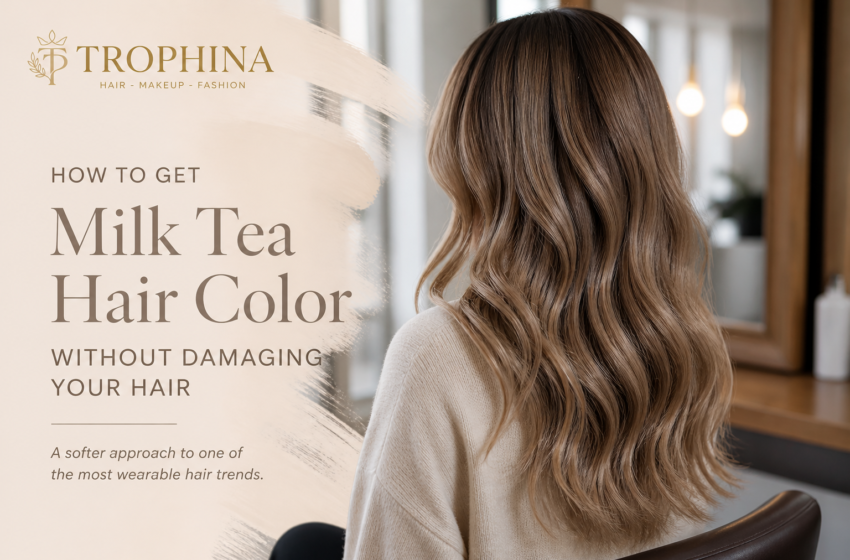
How to Get Milk Tea Hair Color Without Damaging Your Hair

There’s a moment where the colour you want stops being the difficult part.
And the condition of your hair becomes the real concern.
Milk tea hair looks soft. Easy, even. Like it just sits that way naturally.
But getting there — especially from darker hair — doesn’t always feel as effortless.
The difference usually comes down to how far you try to push it.
This is why so many people are looking for ways to get milk tea hair color without damaging their hair.
See the full trend breakdown → Milk Tea Hair Color Balayage
It’s not about going as light as you can
That instinct to go lighter, faster — it’s usually what causes the problem.
Milk tea tones don’t need extreme lift.
They sit somewhere in between. Not blonde, not brown. Pushing past that point doesn’t improve the colour.
It just takes something away from the hair itself.
Slower always looks better later
Good colour rarely happens all at once.
It builds.
Hair holds onto its shape more when it’s lifted gradually. There’s still some depth left in it, which is what keeps the colour from looking flat afterwards.
When everything happens too quickly, the softness disappears first.
Balayage leaves room for variation
Full colour can feel heavy with this kind of tone.
Balayage doesn’t try to make everything match.
Some pieces stay deeper. Others lift more. That variation is what creates that blurred, blended look people usually associate with this colour.
It feels less controlled. Which is why it works.
The tone matters more than the lift
Most of what people recognise as “milk tea” happens after.
Once the hair is lightened, the tone is adjusted — slightly cooler, slightly warmer, depending on what suits the skin.
Too cool, and it goes flat.
Too warm, and it loses that muted feel.
Somewhere in between is where it settles.
Condition changes how the colour reads
The same colour can look completely different depending on the hair underneath it.
Dry hair reflects light differently. It looks sharper, less blended.
When the hair is hydrated, everything softens.
That’s usually the difference people notice, even if they can’t explain it.
It doesn’t need to look perfect
Trying to make every strand match is usually what makes it look artificial.
Milk tea hair works because it isn’t exact.
There’s always a bit of irregularity. A bit of movement.
That’s what keeps it from feeling dyed.
Leaving something for later isn’t a bad thing
It’s tempting to try to get everything done in one appointment.
But most of the time, the better version of this colour shows up later.
The hair stays stronger. The tone holds longer.
And the result ends up looking more natural anyway.
Trophina
If you’re leaning towards colour that feels softer — less defined, easier to wear, less forced — this is usually where it starts.
Nothing too controlled. Nothing overly polished.
Just something that works once you actually live with it.